


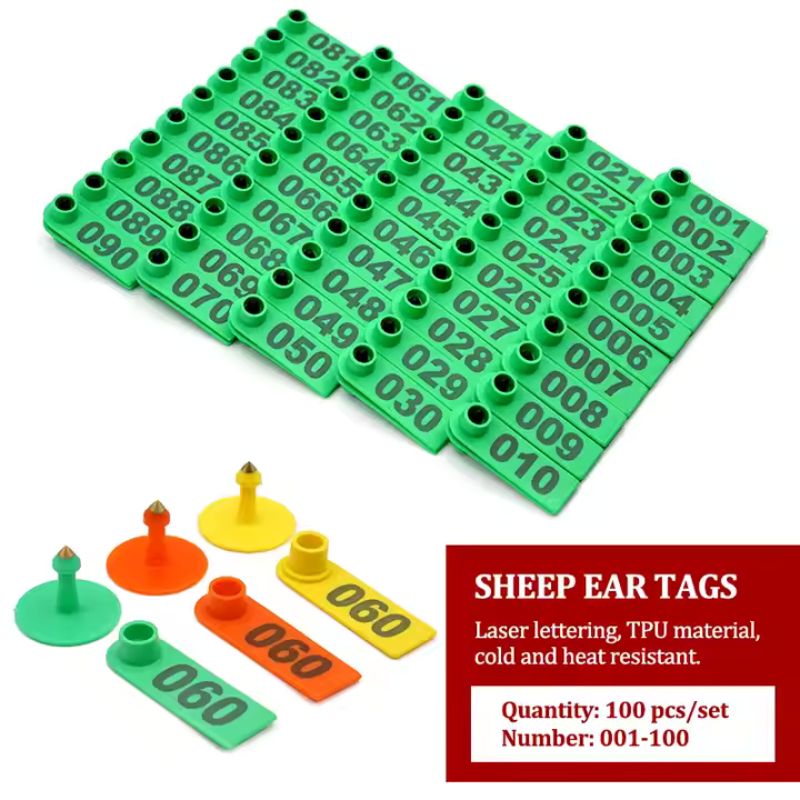
What Goat Ear Tags Do
Goat ear tags give every animal a unique ID — both visual and electronic. The laser-etched number on the surface lets you identify a goat at a glance. The UCODE 8 chip inside stores the same number digitally, so you scan the tag with a reader to pull up health records, breeding data, and milk production logs without catching the animal.
Goats are active. They climb, rub, and head-butt. A heavy tag snags on fences, pulls on thin ear cartilage, and eventually falls off. These tags are built light — the female tag sits close to the ear with minimal weight, and the compact profile stays out of the way when goats push through brush or hop onto feeding platforms.
Why These Tags Work on Goats
- Lightweight for sensitive ears: Low-weight design keeps ear stress minimal — comfortable for dairy kids, meat goats, and breeding stock
- Compact and low-profile: Tag sits close to the ear with a short profile — less snagging on fences, feeders, and brush
- UHF reads at a distance: Scan goats as they move through gates or races without crowding or handling each animal
- Laser-etched backup ID: Number on the tag face stays readable for years — a visual fallback when the reader stays in the barn
- Three color options: Orange, blue, or yellow — sort breeding groups, treatment batches, or age classes by sight
- Secure button lock: Male-female pair locks tight through the ear — stays on through rubbing, climbing, and weather
- IP68 sealed body: Fully waterproof and dustproof — survives rain, mud, and washing without chip damage
Goat Ear Tag Specifications
| Parameter | Specification |
| Material | TPU (Thermoplastic Polyurethane) |
| Chip | UCODE 8 |
| Frequency | 902–928 MHz (UHF) |
| Protocol | ISO 18000-6C |
| Dimensions (Female) | 60 × 30 × 13.5 mm |
| Dimensions (Male) | 25 × 23 mm |
| Weight (Female) | 3.3 g |
| Weight (Male) | 1.5 g |
| Color Options | Orange, Blue, Yellow |
| Reading Distance | 1–3 meters |
| IP Rating | IP68 |
| Tensile Strength | > 270N |
| Operating Temperature | -20°C to +65°C (No icing) |
| Application Temperature | -30°C to +75°C (No icing) |
| ID Marking | Laser-Etched |
| Packaging | 100 pcs per bag |
How to Apply Goat Ear Tags
- Restrain the goat: Use a halter or have a helper hold the goat steady. Goats move quickly, so a calm grip matters.
- Load the tag: Place the male button into the applicator pin, then fit the female tag over the button guide.
- Position on the ear: Center the tag in the middle third of the ear, between the veins. Goat ears are thin — avoid the ridge and the ear tip.
- Squeeze and release: Press the applicator handles firmly until the male button locks through the female tag. Release and check that both halves are seated flush.
- Test the read: Scan the tag with your UHF reader to confirm the ID reads clean before releasing the goat.
Applications
- Herd identification: Assign a unique ID to every goat and link it to your farm management database
- Dairy production tracking: Record milk yields, lactation cycles, and somatic cell counts per goat by scanning at the milking stand
- Health and vaccination management: Record shots, treatments, and vet visits by scanning at the handling chute
- Breeding program management: Track heat cycles, breeding dates, kidding records, and offspring parentage
- Meat goat traceability: Track birth-to-market records for compliance and consumer transparency
- Multi-species small farms: Same tag works for goats and sheep — simplify inventory with one tag model
Ready to Tag Your Goat Herd?
If you manage goats and need ear tags for goats that stay light on sensitive ears, our UHF tags give you the weight, durability, and read range to track every animal without the hassle. The right goat ear tags make every scan count, every health record accurate, and every herd inventory faster.
Request a quote today and tell us your herd size, preferred color, and reader setup. We will help you pick the right ear tags for your goats and get them shipped fast.
FAQ
Q: What are ear tags for goats?
A: Ear tags for goats are identification tags attached to a goat’s ear. They carry a laser-etched number for visual ID and an RFID chip for electronic scanning, letting farmers track health, breeding, and milk records.
Q: Are RFID ear tags safe for goats?
A: Yes. These tags use non-toxic TPU material and a lightweight design that minimizes ear stress. The compact profile reduces snagging and pulling, which is important for active goats that climb and rub.
Q: How far can these goat ear tags be read?
A: These UHF tags read from 1 to 3 meters depending on the reader and environment. That range works well for scanning goats as they pass through a gate or race without stopping each animal.
Q: What color should I choose?
A: You decide. Most goat farms use orange for breeders, blue for kids, yellow for treated animals, or assign colors by breed line. Pick a system that matches your herd management.
Q: Will these tags stay on climbing goats?
A: The secure button lock and compact design help the tag stay in place during climbing, rubbing, and head-butting. No tag is completely loss-proof, but the low profile and strong lock reduce fall-off rates.
Q: Are these tags waterproof?
A: Yes. The TPU body is rated IP68 — fully sealed against water and dust. The tags survive rain, mud, and high-pressure washing without damaging the chip.